Security starts before someone enters your building.
It starts at the gate, the front door, the employee entrance, the shipping and receiving door, the apartment lobby, or the medical office entrance. Every access point affects who can enter your property, where they can go, and how safely people can exit.
That is why access control should not stop at one door.
A well-designed access control system helps your business manage entry from the entrance to the exit. It gives authorized people a simple way to access approved areas while helping keep unauthorized visitors, vendors, vehicles, and former employees out.
At Solucient Security, we help businesses build practical access control systems designed around real daily operations. From gate entrances and employee doors to video intercoms, receiving areas, restricted rooms, and push-to-exit doors, the right system gives you better control without making daily operations harder.
Why Access Control Starts at the Entrance
Every entrance creates a security decision.
When someone approaches a gate, lobby, door, or receiving area, your team needs a clear way to decide whether to allow access. Without a system, that decision often depends on busy employees, manual door releases, physical keys, or doors left unlocked for convenience.
That creates risk.
A delivery driver may enter the wrong area. A vendor may walk into a restricted space. A former employee may still have a key. A side door may stay propped open. A staff member may open a door without knowing who is outside.
Access control replaces guesswork with a clear process. Your business can manage access by user, role, schedule, entrance, and area. That gives your team better control over who enters and better visibility into what happens across the property.
What an Access Control System Can Include
An access control system manages who can enter a building, gate, room, or restricted area.
Depending on the property, the system may include:
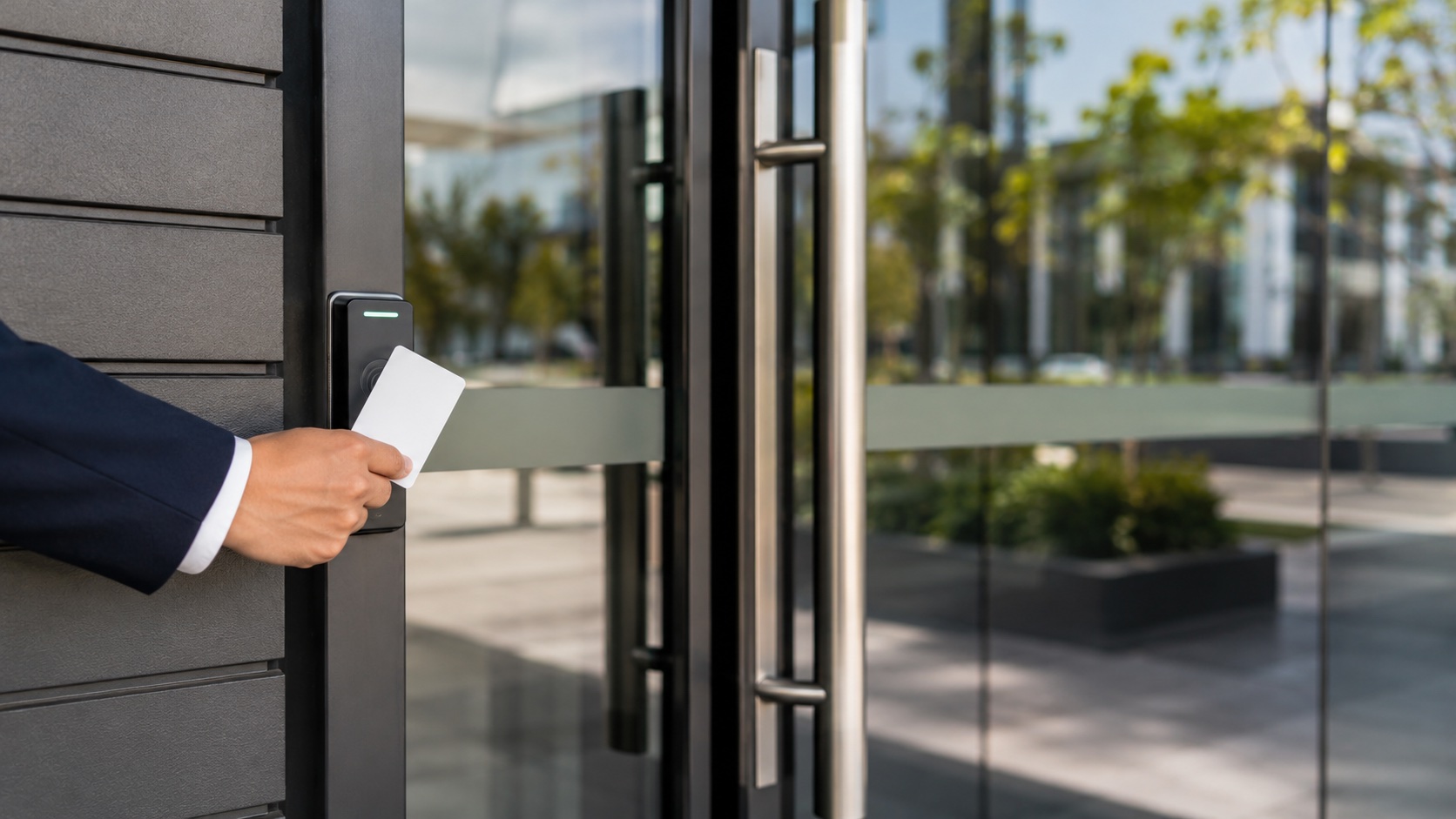
- Key cards, fobs, or mobile credentials
- Card readers or PIN pads
- Electric locks or magnetic locks
- Gate access controls
- Video intercoms
- Door monitoring
- Push-to-exit buttons
- Access control software
- Video surveillance and intrusion detection integration
The goal is simple: let the right people into the right places at the right times.
For example, employees may access the building during work hours. Managers may have after-hours access. Vendors may only access one approved area. Residents may access a lobby, gate, or package room. If someone leaves the organization or moves out, their access can be removed without rekeying the property.
Think Beyond the Front Door
A secure front door matters, but it does not protect the entire property by itself.
Many security gaps happen at side doors, receiving entrances, vehicle gates, employee-only doors, and interior restricted rooms. That is why access control works best when it covers the full path from entrance to exit.
This means looking at:
- Where people and vehicles enter
- Which areas can each person access
- How visitors, vendors, and delivery drivers are managed
- Which interior rooms need stronger control
- How people safely exit through push-to-exit or request-to-exit doors
A manufacturing facility may need gate access, employee credentials, visitor control, production area restrictions, and secure receiving door management. An apartment building may need lobby access, parking gate access, package room access, and controlled maintenance entry. A medical office may need patient entry during the day, staff-only access afterhours, and stronger control for supply or records areas.
Each property works differently. The access control system should match that daily flow.
Gate Entrances
For many properties, security starts before someone reaches the building.
Gate access control helps manage vehicles, vendors, visitors, employees, residents, contractors, and delivery drivers. This is especially useful for road commissions, municipal facilities, manufacturing plants, apartment communities, medical campuses, service yards, and parking areas.
A road commission facility may need to protect vehicles, equipment, materials, garages, and service yards. A manufacturing facility may need to separate employee parking, visitor traffic, and shipping activity. An apartment community may need to manage resident vehicles, guest access, maintenance teams, and deliveries.
Gate access can work with credentials, PINs, video intercoms, remote release, access schedules, and video surveillance. The goal is to control entry without slowing approved traffic.
Video Intercoms for Entrances, Gates, and Receiving Areas
Video intercoms add an important layer of control because they allow staff, residents, or property managers to see and communicate with someone before granting access.
This is useful anywhere visitors, vendors, delivery drivers, or contractors need entry but should not have unrestricted access.
For example, a video intercom at a gate can help a road commission or municipal facility verify a vendor before opening the gate. At a manufacturing facility, staff can communicate with delivery drivers at the shipping and receiving door without leaving the office or production area. In an apartment building, residents or property managers can verify guests before allowing lobby access.
Medical offices can also use video intercoms to manage after-hours visitors, vendors, supply deliveries, or staff-only entrances. This helps the facility stay accessible when needed while keeping sensitive areas protected.
When video intercoms work with access control, businesses can confirm who is requesting access, communicate clearly, and release the correct door or gate when appropriate.
Shipping and Receiving Doors
Shipping and receiving doors are often busy, but they should not be treated like unmanaged back doors.
Delivery drivers, vendors, warehouse staff, contractors, maintenance teams, and employees may all use these doors throughout the day. If the door stays unlocked or gets propped open, it can become one of the easiest ways for unauthorized people to enter.
Access control helps businesses manage when the receiving door is used, who can access it, and how far a visitor or driver can go. When paired with video surveillance or a video intercom, staff can also verify activity before granting access.
A delivery driver does not need access to an entire facility just to complete a delivery. The right system can limit access to the correct entrance or area.
Employee Entrances and Restricted Interior Areas
Employee entrances need to stay convenient, but they also need control.
Access control allows your business to assign access based on role, department, schedule, or location. If an employee leaves, you can remove access. If a credential gets lost, you can disable it. If someone changes roles, you can update their permissions.
This is much easier than managing physical keys.
Access control can also protect restricted interior areas such as IT rooms, server rooms, medication storage, medical record areas, inventory rooms, tool rooms, mechanical rooms, electrical rooms, executive offices, production areas, and employee-only spaces.
This creates layered security. Someone may be allowed inside the building, but that does not mean they should access every room.
Push-to-Exit Doors and Safe Exiting
Access control should manage entry, but it must also support safe exit.
Push-to-exit buttons, request-to-exit sensors, door release devices, emergency egress hardware, door monitoring, exit alarms, and fire and life safety integration may all play a role depending on the property.
This is especially important for doors with electric locks or magnetic locks.
A strong access control plan considers both sides of the door. It controls who can enter while making sure people can exit safely during daily use and emergencies.
Access Control by Property Type
Different properties need different access control strategies.
- Road commissions and municipal facilities often need gate access, employee access, vendor control, garage access, service yard protection, and after-hours entry management.
- Manufacturing facilities may need to control employee entrances, visitor access, production areas, shipping and receiving doors, tool rooms, inventory storage, and maintenance spaces.
- Apartment buildings and multi-tenant properties need convenient access for residents while controlling guest access, parking gates, package rooms, maintenance entry, and shared spaces.
- Medical offices and healthcare facilities need to balance patient access with stronger control over staff areas, medication rooms, supply rooms, medical records, vendor access, and after-hours entrances.
- Multi-location businesses need consistent access permissions, reporting, remote updates, and scalable systems across different sites.
When Your Property May Need Better Access Control
Your business may need to install or upgrade access control if:
- You still rely heavily on physical keys.
- You do not know who currently has access.
- Former employees, tenants, or vendors may still have keys.
- Doors stay propped open.
- Staff manually unlock doors throughout the day.
- Gate access feels hard to manage.
- Shipping and receiving doors lack proper control.
- Visitors enter without verification.
- Restricted rooms remain unsecured.
- You manage multiple locations with inconsistent systems.
These issues usually grow as your property adds more people, doors, vendors, schedules, and locations.
Ready to Improve Access Control Across Your Property?
If several of these issues sound familiar, Solucient Security can help evaluate your entrances, gates, doors, and restricted areas to build a more practical access control plan.
Our team can help you identify where access gaps exist, how people move through your property, and which access control solutions make the most sense for your daily operations.
Why Integration Matters
Access control becomes stronger when it works with the rest of your security system.
Access control can show that someone used a credential. Video surveillance can show who used it and what happened at the door. Intrusion detection can help identify unauthorized after-hours entry. Door monitoring can show whether someone forced a door open or left it open too long.
A connected system gives your team better visibility and better control across entrances, gates, receiving areas, restricted rooms, and exit points.
Build Access Control Around How Your Property Works
Access control is not just hardware on a door. It requires planning.
A good security partner should look at how people enter, move through, and exit the property. That includes gates, employee entrances, visitor paths, receiving areas, restricted rooms, after-hours needs, existing cameras, existing alarms, fire and safety requirements, monitoring needs, and future expansion.
The right solution should match the property.
A manufacturing facility does not operate like an apartment building. A medical office does not have the same access needs as a road commission facility. A shipping and receiving entrance does not function like a main lobby.
Access control should support real daily use, not a generic checklist.
Secure Your Property From Entrance to Exit
Securing your property starts at the entrance, but it should not stop there.
A complete access control strategy looks at how people and vehicles move across the full property. That includes gates, front entrances, employee doors, shipping and receiving areas, restricted rooms, video intercoms, and push-to-exit points.
When these access points work together, your business gains better control, stronger visibility, and a stronger security foundation.
At Solucient Security, we help businesses design practical commercial security systems that protect people, property, and peace of mind. Our access control solutions help organizations manage who can enter, where they can go, and when they can access specific areas.
Whether you need to secure a gate entrance, employee door, manufacturing facility, apartment building, medical office, shipping and receiving area, municipal property, or multi-location business, our team can help you build an entrance-to-exit strategy that fits the way your property operates.
Solucient Security also supports businesses with video surveillance, intrusion detection, fire and safety systems, emergency notification systems, and industrial process monitoring.
If your current system depends too heavily on physical keys, manual door releases, unsecured delivery doors, disconnected entrances, or limited visibility, we can help you create a smarter access control solution from the first entrance to the final exit.
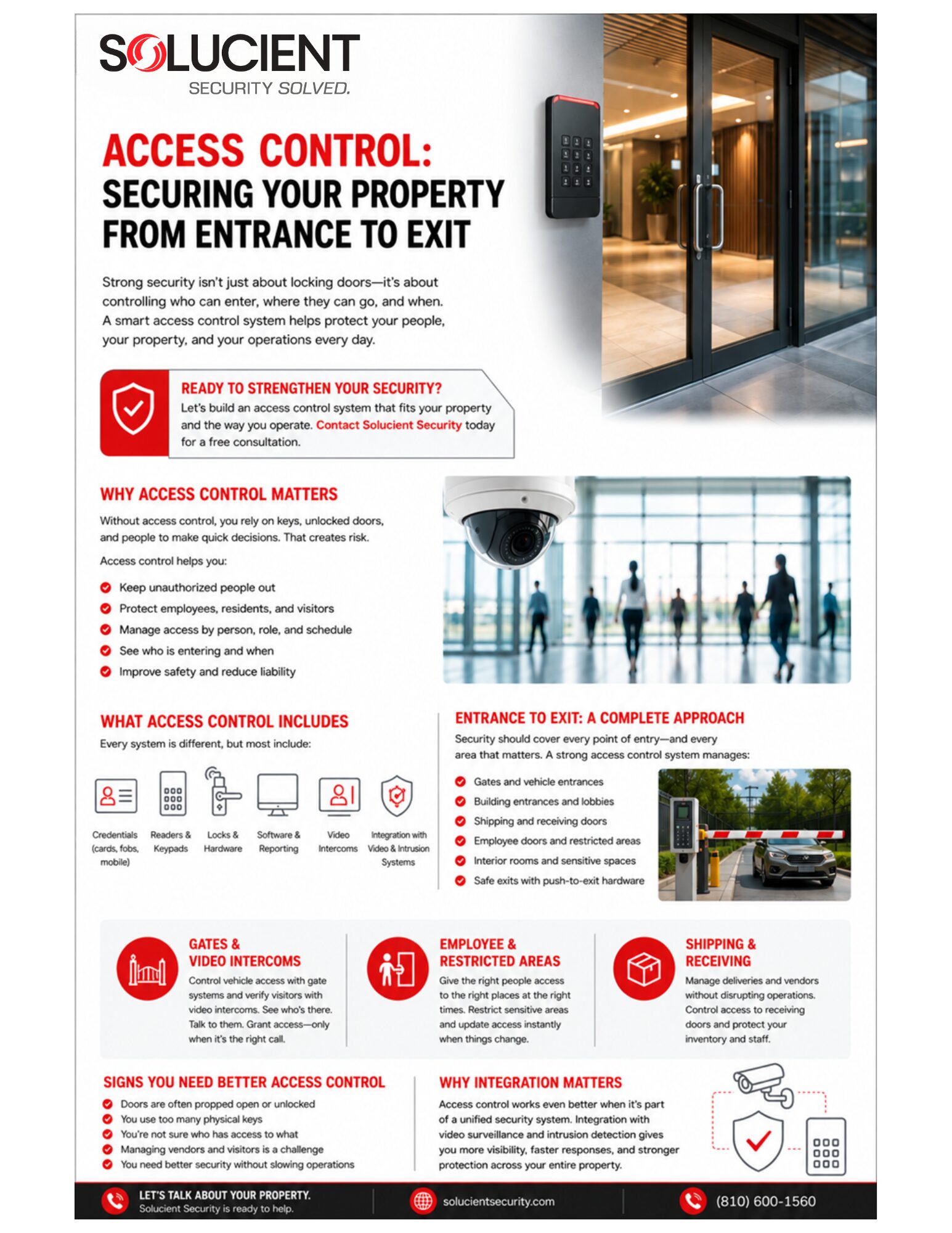
Prefer the Quick Visual Version?
Click below to expand/download a simplified snapshot of the key access control concepts covered in this article.