
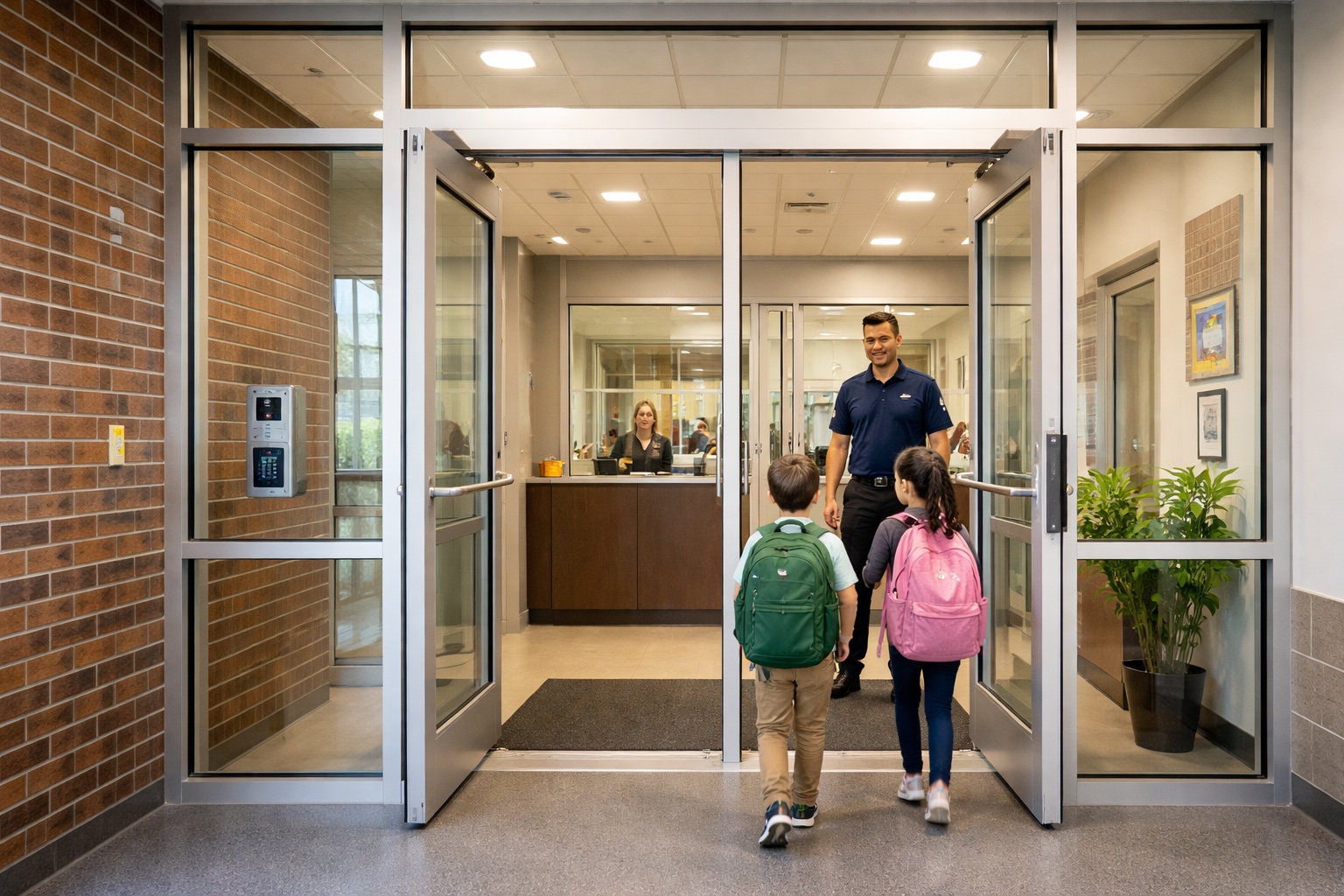
School safety begins at the front door. As schools face increasing concerns around unauthorized access, visitor accountability, and emergency preparedness, administrators now place greater emphasis on how people enter the building, not just what happens once they are inside. Even strong internal safety procedures can fall short if entry points remain open or loosely controlled.
Secured vestibules give schools a practical, highly effective way to manage entry. They allow staff to pause, verify, and approve access before visitors reach student or staff areas. When schools combine secured vestibules with access control, video surveillance, and intrusion detection, they create a transparent, repeatable process that strengthens safety without disrupting daily operations or creating a hostile environment.
This article explains secured vestibules in straightforward terms, what they are, how they work in schools, why they matter, and how Solucient Security helps schools design and implement reliable entry security solutions.
What Is a Secured Vestibule?
A secured vestibule is a controlled entry space located between the outside of the school and the interior learning or administrative areas. Instead of allowing visitors to walk directly into hallways or offices, the vestibule creates a buffer zone where staff can evaluate access before allowing entry.
How Vestibules Change the Entry Experience
Most secured vestibules include an exterior door that allows visitors into the vestibule and an interior door that remains locked by default. Staff maintain visibility into the vestibule and use integrated security systems to verify visitors. This design ensures that every person entering the building does so intentionally and with approval, rather than by assumption or chance.
Rather than relying solely on staff availability or reaction time, the vestibule itself enforces access control through its physical layout and supporting systems.
How Secured Vestibules Function in Schools
Secured vestibules integrate smoothly into everyday school routines while adding an essential layer of protection. Schools use them to establish a consistent and predictable entry process.
A Typical School Entry Workflow
A visitor approaches the main entrance and enters the vestibule through the exterior door. The interior door remains locked, preventing unsupervised movement into the building. School staff then verify the visitor using two-way communication systems, video surveillance, and established visitor identification procedures. Once staff confirm the visitor’s purpose and authorization, they unlock the interior door and direct the visitor according to school policy.
This structured workflow removes ambiguity, reduces pressure on front office staff, and ensures that access decisions remain deliberate rather than reactive.
Why Secured Vestibules Matter for School Safety
Addressing High-Traffic Entry Risks
School entrances experience the highest concentration of movement, especially during arrival, dismissal, lunch periods, and school events. Without controlled entry, these moments create opportunities for unauthorized access. Secured vestibules ensure that high-traffic periods do not translate into higher risk.
Preventing Tailgating and Unapproved Access
One of the most common access issues in schools is tailgating. Unauthorized individuals can follow students, staff, or visitors into the building unnoticed. Secured vestibules prevent this by requiring active approval before interior access occurs, regardless of how busy the entrance becomes.
Supporting a Layered Security Strategy
Effective school security does not rely on a single solution. Schools combine physical design, access control, video surveillance, intrusion detection, and staff procedures to create a layered defense. Secured vestibules serve as the anchor point that connects these layers at the most critical location, the entrance.
Building Confidence Across the School Community
Clear and consistent entry procedures reassure parents, staff, and students. When people see that access is managed intentionally and consistently, trust in the school’s safety approach increases.
Key Components of an Effective Secured Vestibule
A secured vestibule works best when physical design and technology function as a single, coordinated system.
Access Control for Intentional Entry
Access control systems allow schools to lock and unlock doors instantly, assign permissions to staff, and maintain detailed access records. These systems give administrators real-time control and reduce reliance on manual processes or ad-hoc. Proper access control allows isolation of disgruntled or threating individuals from the school population.
Video Surveillance for Visibility and Awareness
Video surveillance supports visibility at critical points, including exterior approaches, activity inside the vestibule, and interior entry doors. Clear visibility allows staff to make informed access decisions and provides documentation if incidents require review.
Communication Systems for Verification
Intercom and two-way communication systems allow staff to speak directly with visitors before granting access. This interaction adds clarity, context, and a human verification step that improves decision-making.
Intrusion Detection for Rapid Response
Intrusion detection systems monitor for forced entry or unauthorized access attempts. When someone tries to bypass the vestibule or force a door, the system generates immediate alerts, enabling faster response and reducing potential impact.
Reinforced Entry Features When Required
Based on risk assessments, some schools include reinforced doors, impact-resistant glazing, or advanced locking mechanisms. These features increase resistance and delay unauthorized entry, buying valuable time during critical situations.
Benefits of Secured Vestibules for Schools
Improved Safety for Students and Staff
By controlling access at the front door, schools significantly reduce the risk of unauthorized individuals entering learning spaces and administrative areas.
Clear Visitor Accountability
Secured vestibules support structured visitor management. Schools maintain a clear understanding of who is on campus, why they are there, and how long they remain.
Reduced Risk and Liability
Controlled entry points demonstrate proactive safety planning and alignment with widely accepted school security practices, helping reduce operational risk and liability.
Stronger Emergency Preparedness
During emergencies, secured vestibules help limit external access and support lockdown and coordinated response procedures.
Planning a Secured Vestibule for Your School
Step 1: Identify Entry Risks and Needs
Schools begin by assessing current entry points, traffic patterns, and vulnerabilities to understand where improvements are most needed.
Step 2: Design for Visibility and Control
Administrators plan vestibule layouts that balance security, staff sightlines, accessibility, and visitor flow.
Step 3: Select the Right Security Technologies
Schools choose access control, video surveillance, communication, and intrusion detection systems that align with daily operations and staff capabilities.
Step 4: Integrate, Train, and Maintain
Professional installation ensures systems work together seamlessly. Staff training reinforces consistent use, while regular reviews and maintenance keep the vestibule effective as needs evolve.
Conclusion: Our Commitment to Safer School Entrances
At Solucient Security, we view secured vestibules as one of the most effective ways schools can strengthen safety at the point where it matters most, the entrance. A well-designed vestibule gives schools control, clarity, and confidence, without disrupting learning or creating unnecessary barriers.
We work directly with school administrators to assess risks, design practical vestibule solutions, and integrate access control, video surveillance, and intrusion detection into a cohesive security strategy. Our focus is always on solutions that perform reliably in real school environments, not just on paper.
If your school is planning to improve entry security, our team is ready to help. From initial assessment through long-term support, we partner with you to create safer, more secure school environments, starting at the front door.